
The Question
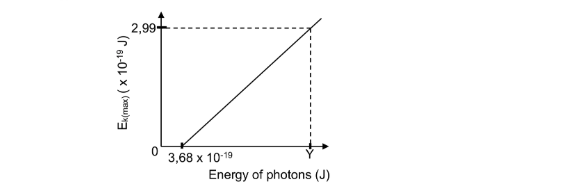
Sketch graph showing maximum kinetic energy (Ek(max) in x 10⁻¹⁹ J) on the y-axis versus energy of photons (J) on the x-axis. The graph is a straight line with a positive slope, starting from a positive x-intercept (3.68 x 10⁻¹⁹ J) and a positive y-intercept (2.99 x 10⁻¹⁹ J), extending to a point Y on the x-axis.
Light of different frequencies is incident on a metal plate. The sketch graph below shows the relationship between the maximum kinetic energy, Ek(max), of the photoelectrons and the energy of the incident photons. Write down the numerical value of the gradient of the above graph.
Details
💡 Hint
Consider the mathematical form of the photoelectric equation and how it relates to the general equation of a straight line (y = mx + c). What does the coefficient of the independent variable (photon energy) represent?
📝 Solution Steps
- Step 1: Write down the photoelectric equation: Ek(max) = E – W₀.
- Step 2: Identify the variables plotted on the y-axis (Ek(max)) and x-axis (E) of the given graph.
- Step 3: Compare the photoelectric equation to the standard linear equation y = mx + c.
- Step 4: Determine the value of the gradient (m) from this comparison.
📚 Explanation
The photoelectric equation states that the maximum kinetic energy of an emitted photoelectron (Ek(max)) is equal to the energy of the incident photon (E) minus the work function (W₀) of the metal: Ek(max) = E – W₀. This equation is in the form of a straight line, y = mx + c, where y = Ek(max), x = E, and the gradient (m) is 1. The y-intercept is -W₀, and the x-intercept is W₀. Therefore, the numerical value of the gradient is 1.
✅ Answer
1
⚠️ Common Mistakes
- Confusing the gradient with the x-intercept (work function) or y-intercept.
- Not recognizing the direct linear relationship implied by the photoelectric equation.
📐 Formulas Required
- Ek(max) = E – W₀