
The Question
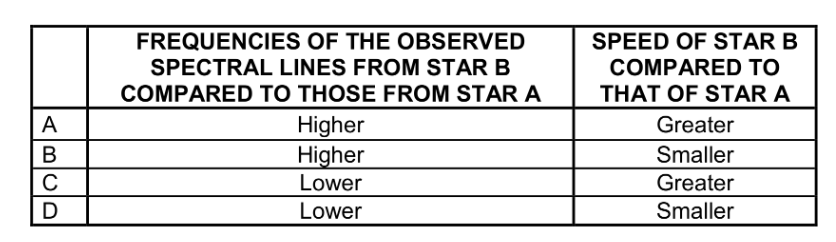
The absorption spectra of the same element surrounding both star A and star B are observed from Earth. The spectral lines for star B are more red-shifted than those for star A. How do the frequencies of the observed spectral lines and the speed of star B compare to that of star A? The options are presented in a table with columns ‘FREQUENCIES OF THE OBSERVED SPECTRAL LINES FROM STAR B COMPARED TO THOSE FROM STAR A’ and ‘SPEED OF STAR B COMPARED TO THAT OF STAR A’. A) Higher, Greater. B) Higher, Smaller. C) Lower, Greater. D) Lower, Smaller.
Details
💡 Hint
Remember that red-shift means light is ‘stretched’ to longer wavelengths. How does this affect frequency, and what kind of motion causes this stretching?
📝 Solution Steps
- 1. Define red-shift in terms of wavelength and frequency.
- 2. Relate red-shift to the relative motion between the light source and the observer.
- 3. Compare the degree of red-shift for star A and star B to determine their relative speeds and observed frequencies.
📚 Explanation
Red-shift indicates that the observed wavelength of light is longer than the emitted wavelength, which means the observed frequency is lower. According to the Doppler effect, this occurs when the source of light (star B) is moving away from the observer (Earth). A greater red-shift implies a greater speed of recession. Therefore, the frequencies of the spectral lines from star B will be LOWER than those from star A, and star B will be moving at a GREATER speed compared to star A.
✅ Answer
C
⚠️ Common Mistakes
- Confusing red-shift with blue-shift (which indicates motion towards the observer).
- Incorrectly relating frequency/wavelength changes to the speed of the source.