

The Question
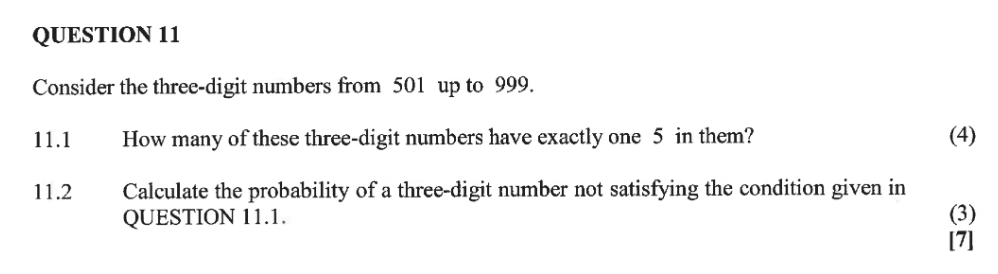
[From question 11.1]: Consider the three-digit numbers from 501 up to 999. How many of these three-digit numbers have exactly one 5 in them?
Consider the three-digit numbers from 501 up to 999. Calculate the probability of a three-digit number not satisfying the condition given in QUESTION 11.1 (having exactly one 5).
Details
💡 Hint
When asked for the probability of an event *not* happening, it’s often easier to calculate the probability of the event *happening* and subtract it from 1. Remember to correctly identify the total number of possible outcomes in the given range.
📝 Solution Steps
- Step 1: Calculate the total number of three-digit numbers in the specified range (501 to 999).
- Step 2: Identify the number of outcomes that satisfy the condition from Question 11.1 (having exactly one ‘5’).
- Step 3: Calculate the probability of satisfying the condition from Question 11.1.
- Step 4: Apply the complementary probability rule: P(not A) = 1 – P(A).
📚 Explanation
This question asks for the probability of a three-digit number (from 501 to 999) *not* satisfying the condition from Question 11.1 (i.e., not having exactly one ‘5’). This is a classic complementary probability problem.
**Step 1: Determine the total number of possible outcomes.**
The three-digit numbers range from 501 to 999, inclusive. To find the total count, we use the formula: Last Number – First Number + 1.
Total numbers = 999 – 501 + 1 = 499.
**Step 2: Recall the number of favorable outcomes for the original condition (from Question 11.1).**
From Question 11.1, we found that there are 152 numbers with exactly one ‘5’ in the range 501 to 999.
**Step 3: Calculate the probability of a number having exactly one ‘5’.**
P(exactly one ‘5’) = (Number of numbers with exactly one ‘5’) / (Total number of numbers)
P(exactly one ‘5’) = 152 / 499.
**Step 4: Use the complementary probability rule.**
The probability of an event *not* happening is 1 minus the probability of the event *happening*.
P(not exactly one ‘5’) = 1 – P(exactly one ‘5’)
P(not exactly one ‘5’) = 1 – (152 / 499)
P(not exactly one ‘5’) = (499 – 152) / 499
P(not exactly one ‘5’) = 347 / 499.
As a decimal, 347 / 499 ≈ 0.69539… which rounds to 0.70 (to two decimal places).
✅ Answer
347/499 or 0.70
⚠️ Common Mistakes
- Incorrectly calculating the total number of outcomes in the range.
- Forgetting to subtract the probability from 1.
- Using the result from 11.1 directly as the numerator for the ‘not satisfying’ condition without subtracting from the total.
📐 Formulas Required
- P(Event) = (Number of favorable outcomes) / (Total number of outcomes)
- P(not Event) = 1 – P(Event)