
The Question
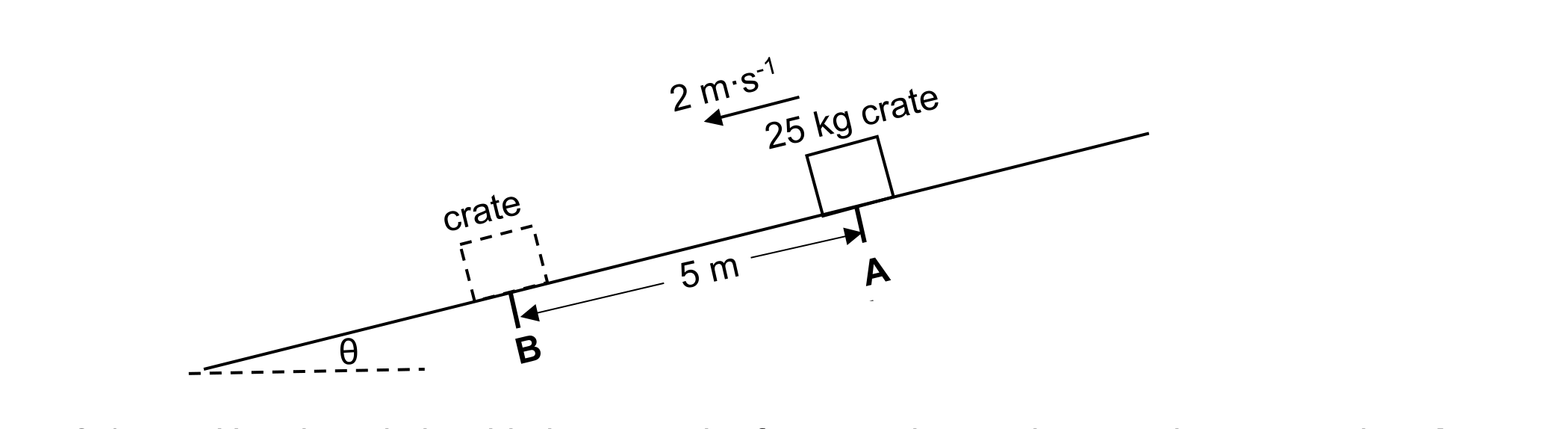
[Visual element]: Diagram of a 25 kg crate sliding down a rough inclined plane at 30 degrees, with an applied force F parallel to the incline.
A crate of mass 25 kg slides down a rough inclined plane at a constant speed of 2 m·s⁻¹ towards point A while force F acts on it, parallel to the incline, as shown in the diagram. A constant kinetic frictional force of 40 N acts on the crate when the plane is inclined at an angle of 30° with the horizontal. Calculate the magnitude of F.
Details
💡 Hint
Remember that ‘constant speed’ is a direct clue about the net force. Break down the gravitational force into components parallel and perpendicular to the incline.
📝 Solution Steps
- Recognize that ‘constant speed’ implies the net force is zero.
- Identify all forces acting parallel to the inclined plane.
- Write down the equation for force equilibrium along the incline.
- Substitute the given values for mass, gravity, angle, and friction.
- Solve the equation for the unknown force F.
📚 Explanation
The key information here is that the crate slides down at a *constant speed*. According to Newton’s First Law, if an object moves at a constant velocity (which includes constant speed in a straight line), the net force acting on it is zero (F_net = 0).
1. **Resolve forces parallel to the incline**: We need to consider the component of gravity acting down the incline (Fg_parallel = mg sinθ), the kinetic friction (fk) acting up the incline, and the applied force (F) acting up the incline (as shown in the diagram and implied by constant speed).
2. **Set up the equilibrium equation**: Since F_net = 0, the sum of forces acting up the incline must equal the sum of forces acting down the incline.
F + fk = Fg_parallel
F + fk = mg sinθ
3. **Substitute known values**: We are given:
* Mass (m) = 25 kg
* Acceleration due to gravity (g) = 9.8 m/s²
* Angle of inclination (θ) = 30°
* Kinetic frictional force (fk) = 40 N
F + 40 N = (25 kg)(9.8 m/s²)sin(30°)
F + 40 N = (245 N)(0.5)
F + 40 N = 122.5 N
4. **Solve for F**:
F = 122.5 N – 40 N
F = 82.5 N
✅ Answer
F = 82.5 N
⚠️ Common Mistakes
- Incorrectly resolving the gravitational force (e.g., using cosθ instead of sinθ for the parallel component).
- Misidentifying the direction of the applied force or friction.
- Forgetting that the net force is zero when speed is constant.
📐 Formulas Required
- F_net = 0
- Fg_parallel = mg sinθ