
The Question
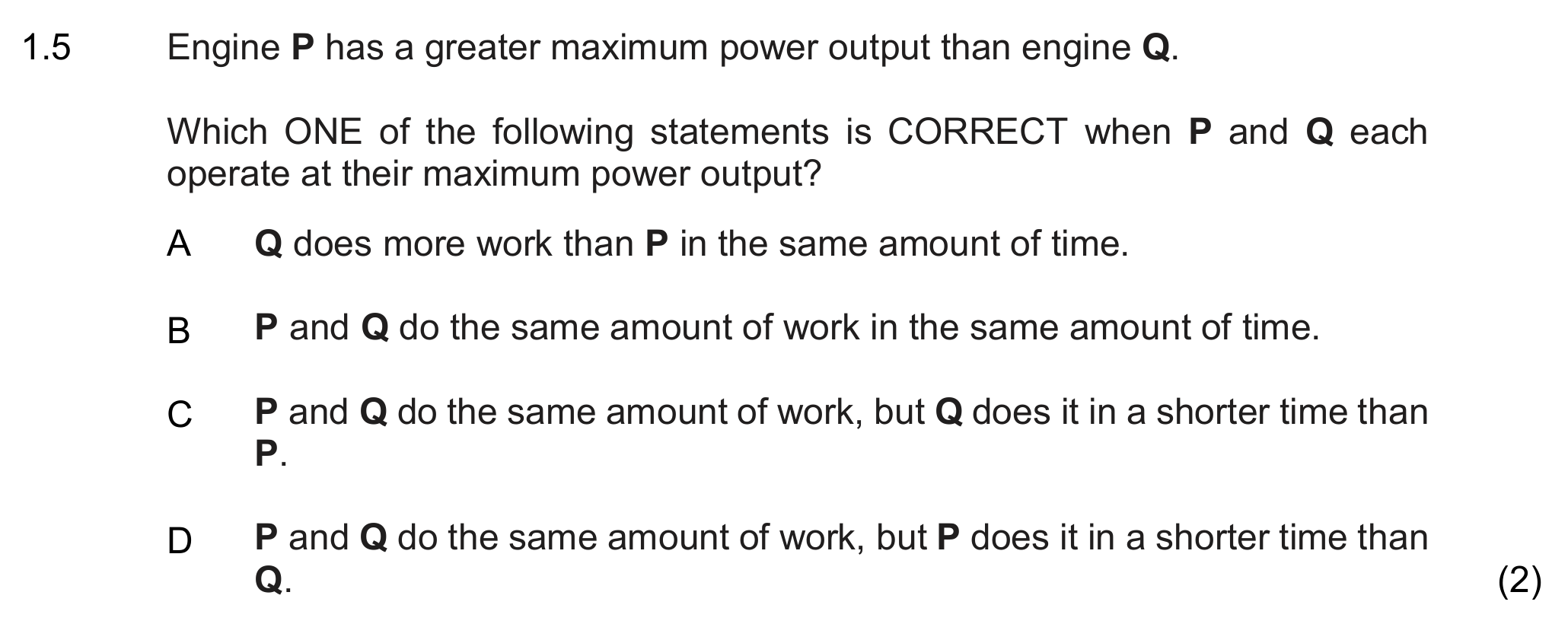
Engine P has a greater maximum power output than engine Q. Which ONE of the following statements is CORRECT when P and Q each operate at their maximum power output? The options are: A) Q does more work than P in the same amount of time. B) P and Q do the same amount of work in the same amount of time. C) P and Q do the same amount of work, but Q does it in a shorter time than P. D) P and Q do the same amount of work, but P does it in a shorter time than Q.
Details
💡 Hint
Think about the definition of power: it’s how quickly work is done. If you have more power, what does that mean for the time it takes to do a certain amount of work?
📝 Solution Steps
- Recall the definition of power (P = W/Δt).
- Understand what ‘greater maximum power output’ implies for work and time.
- Evaluate each option based on this understanding.
📚 Explanation
Power is defined as the rate at which work is done, or P = W/Δt. If engine P has a greater maximum power output than engine Q, it means that for any given amount of time (Δt), engine P can do more work (W) than engine Q. Alternatively, for the same amount of work (W), engine P can do it in a shorter amount of time (Δt) compared to engine Q. Option D correctly states that P and Q do the same amount of work, but P does it in a shorter time than Q, which aligns with P having a greater power output.
✅ Answer
D
⚠️ Common Mistakes
- Confusing power with work.
- Incorrectly relating power to time for a given amount of work.
📐 Formulas Required
- P = W/Δt