
The Question
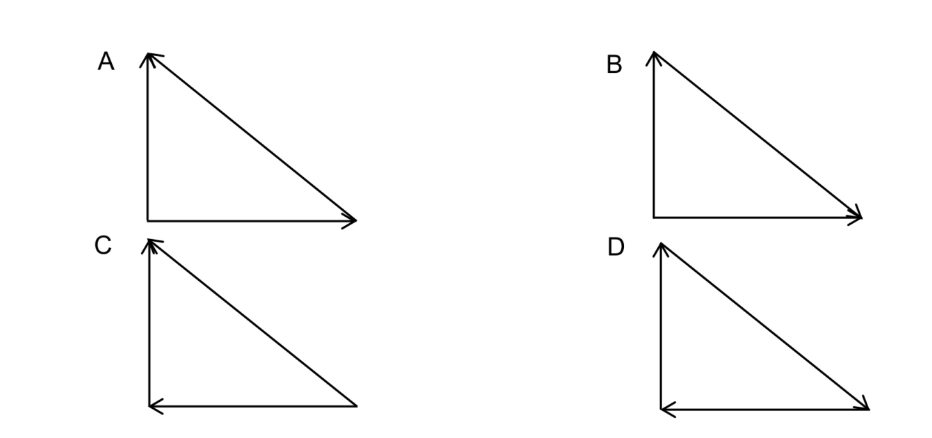
Four vector diagrams (A, B, C, D) each showing three vectors arranged head-to-tail, representing forces.
Three forces act on an object so that the resultant force is zero. Which ONE of the following vector diagrams is the CORRECT representation of the three forces? The options are four vector diagrams (A, B, C, D) showing three vectors arranged head-to-tail.
Details
💡 Hint
Remember, for forces to balance out to zero, their vector sum must be zero. Think about how you graphically add vectors head-to-tail.
📝 Solution Steps
- Understand the meaning of ‘resultant force is zero’ in vector terms.
- Recall the head-to-tail method for vector addition.
- Identify which diagram forms a closed loop when vectors are added head-to-tail.
📚 Explanation
When the resultant force on an object is zero, the object is in equilibrium. This means that if you add all the force vectors acting on the object using the head-to-tail method, the final vector should end where the first vector began, forming a closed polygon. In other words, the net displacement from the start of the first vector to the end of the last vector is zero. Looking at the diagrams, only option D shows a closed vector polygon where the vectors are added head-to-tail, indicating a zero resultant force.
✅ Answer
D
⚠️ Common Mistakes
- Misinterpreting vector addition rules (e.g., adding tail-to-tail).
- Not understanding that a zero resultant force means the vectors form a closed loop.