

The Question
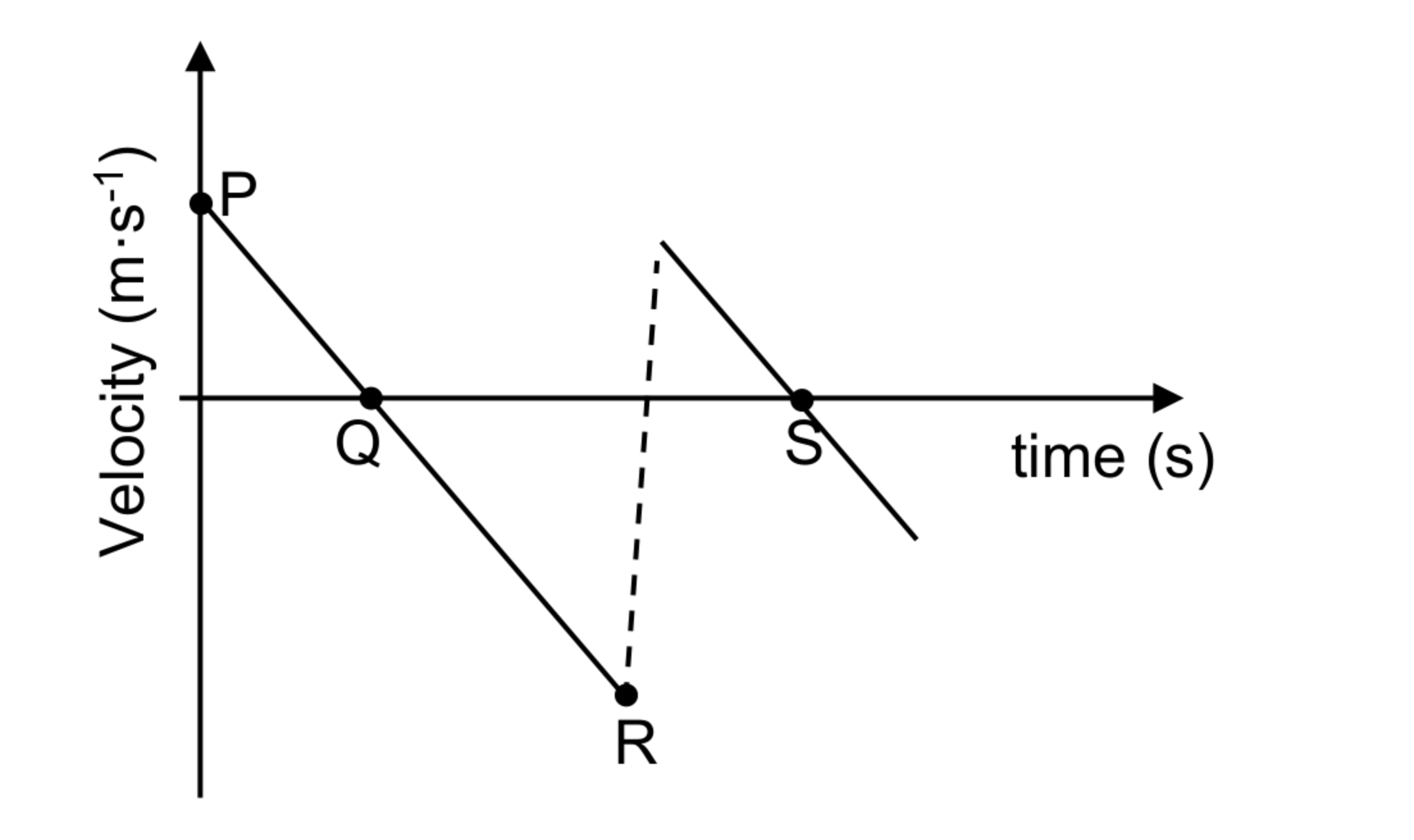
Velocity versus time graph for a ball projected vertically upwards. The graph is a straight line with a negative slope, starting at positive velocity (P), crossing the time axis (Q), and continuing to negative velocity (R, S).
The velocity versus time sketch graph below is for the motion of a ball that is projected vertically upwards from the top of a building. The ball reached its greatest height above the ground at a certain time. Which point on the graph corresponds to this greatest height? The graph shows velocity (m·s⁻¹) on the y-axis and time (s) on the x-axis. The line starts at point P (positive velocity), decreases linearly, crosses the x-axis at point Q, continues linearly into negative velocity, and ends at point S. Point R is on the negative velocity part of the graph.
Details
💡 Hint
What is the velocity of any object at the very peak of its vertical trajectory, just before it starts to fall?
📝 Solution Steps
- Understand the motion of a ball projected vertically upwards.
- Identify the velocity of the ball at its greatest height.
- Locate the point on the velocity-time graph where velocity is zero.
📚 Explanation
When a ball is projected vertically upwards, it slows down as it rises due to gravity. At its greatest height, the ball momentarily stops before it starts falling back down. This means its instantaneous velocity at the highest point is zero. On a velocity-time graph, zero velocity corresponds to the point where the graph line crosses the time (x) axis. In the given graph, point Q is where the velocity is zero.
✅ Answer
B
⚠️ Common Mistakes
- Confusing the highest point with the starting point (P) or a point during the descent (R, S).
- Misinterpreting the axes of the graph.